Memory Care in Baltimore, MD: Services, Costs & How to Choose
When a loved one with Alzheimer’s disease or another dementia needs more supervision than can safely be provided at home, families may begin considering memory care in Baltimore.
Memory care is not one identical type of facility. In Maryland, dementia care may be provided within a licensed assisted living program, and an assisted living program must receive state approval before operating or marketing an Alzheimer’s Special Care Unit.
What is memory care?
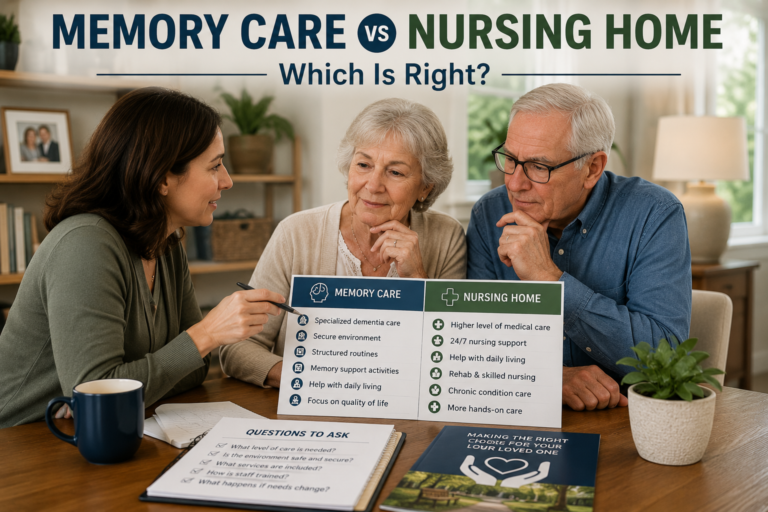
Memory care generally refers to residential care designed for people with dementia who need structured routines, supervision, help with daily activities, and dementia-informed support. Services and staffing vary by community.
When might memory care be appropriate?
A diagnosis alone does not determine the right setting. Consider whether dementia is causing unsafe wandering, repeated medication mistakes, nighttime confusion, difficulty eating or completing personal care, falls, inability to recognize emergencies, or caregiving demands that can no longer be managed safely.
If significant nursing or medical needs are the primary issue, a nursing facility may be more appropriate. See Memory Care vs Nursing Home.
Maryland rules for Alzheimer’s Special Care Units
Maryland’s current assisted living regulations require Department approval before an assisted living program operates or advertises an Alzheimer’s Special Care Unit. The program must maintain a written description explaining how its specialized care differs from nonspecial care and disclose that description on request and before admission to the special care unit.
Ask whether the dementia program is an approved Alzheimer’s Special Care Unit, what specialized services it provides, and how those services differ from the rest of the community.
How much does memory care cost in Baltimore?
Memory care may cost more than standard assisted living because residents can require additional supervision, specialized programming, staffing, and safety features. There is no single government-set Baltimore memory-care rate, and communities structure pricing differently.
For context, our current Baltimore assisted living cost guide explains the underlying assisted-living market. Our separate Baltimore memory-care cost guide will address dementia-care pricing specifically.
What to compare when touring memory care
- How dementia-related needs are assessed before admission.
- Who is present overnight and how staff respond to wandering or distress.
- How medication administration and health changes are handled.
- How staff are trained for dementia-related communication and behaviors.
- How the environment addresses wandering and exit risks.
- How meals and hydration are supported.
- How activities are adapted to cognitive ability.
- How families are notified about falls, behavioral changes, weight loss, or other significant changes.
- What needs would eventually require transfer.
Check Maryland licensing and oversight
Verify the assisted living program through Maryland OHCQ. Ask to see its posted license, confirm its licensed level of care, and ask about recent surveys and any plan of correction. OHCQ licenses and oversees Maryland Assisted Living Programs.
For a broader selection process, see How to Choose Assisted Living in Baltimore.
Paying for memory care
Medicare generally does not pay the ongoing room, board, and custodial-care cost of residential memory care. Medicare may still cover otherwise eligible medical services.
Some eligible Maryland residents may receive approved assisted living services through the Community Options Waiver, but medical, financial, technical, provider-participation, and availability requirements apply. See Does Medicaid Pay for Assisted Living in Maryland?
Use one dementia-needs profile across every Baltimore tour
Write down the resident’s supervision needs, wandering or exit-seeking history, mobility, medication support, eating and toileting needs, nighttime routine, behaviors, and medical conditions. Give the same profile to each community so “yes, we provide memory care” becomes a comparable care-capability answer.
Use How to Find Memory Care for a Parent for the broader search process and the wandering-safety guide when exit-seeking is a major concern.
Questions to ask before choosing
- What dementia diagnoses and behaviors can you safely support?
- How do you respond to wandering, agitation, or nighttime wakefulness?
- What is included in the base rate and what costs extra?
- How are care-level increases priced?
- What is your licensed level of care?
- Is this an approved Alzheimer’s Special Care Unit?
- What would cause a resident to need another setting?
- How are families involved in care planning?
Explore memory care options in Baltimore
Nursing Home Placement can help families build an initial Baltimore shortlist. Directory inclusion is not an endorsement and does not guarantee dementia services, pricing, licensing status, Medicaid participation, or availability.
Frequently asked questions
Is memory care the same as a nursing home?
No. Memory care commonly focuses on dementia-related supervision and daily support, while nursing homes provide a higher level of ongoing nursing care. Individual needs and programs vary.
Does Medicare pay for memory care?
Medicare generally does not pay for long-term custodial residential care or room and board. It may cover otherwise eligible medical services.
How do I verify a Baltimore memory care community?
Verify the underlying licensed provider with Maryland OHCQ. If the community markets an Alzheimer’s Special Care Unit, ask about its state approval and required written disclosure.
For a broader Baltimore overview across assisted living, memory care, nursing homes, skilled rehabilitation, costs, and payment questions, see Senior Care in Baltimore, MD: A Complete Guide for Families.
Sources and further reading
- Maryland OHCQ — Assisted Living Programs
- COMAR 10.07.14 — Assisted Living Programs
- Medicare — Long-term care
- National Institute on Aging — Finding Long-Term Care
Last reviewed September 2026. Verify current licensing, services, pricing, and availability before making a care decision.