Memory Care vs Nursing Home: Which Is Right?
Memory care and nursing home care are both used by families who need more support for an aging parent, spouse, or loved one. However, they are not the same type of care.
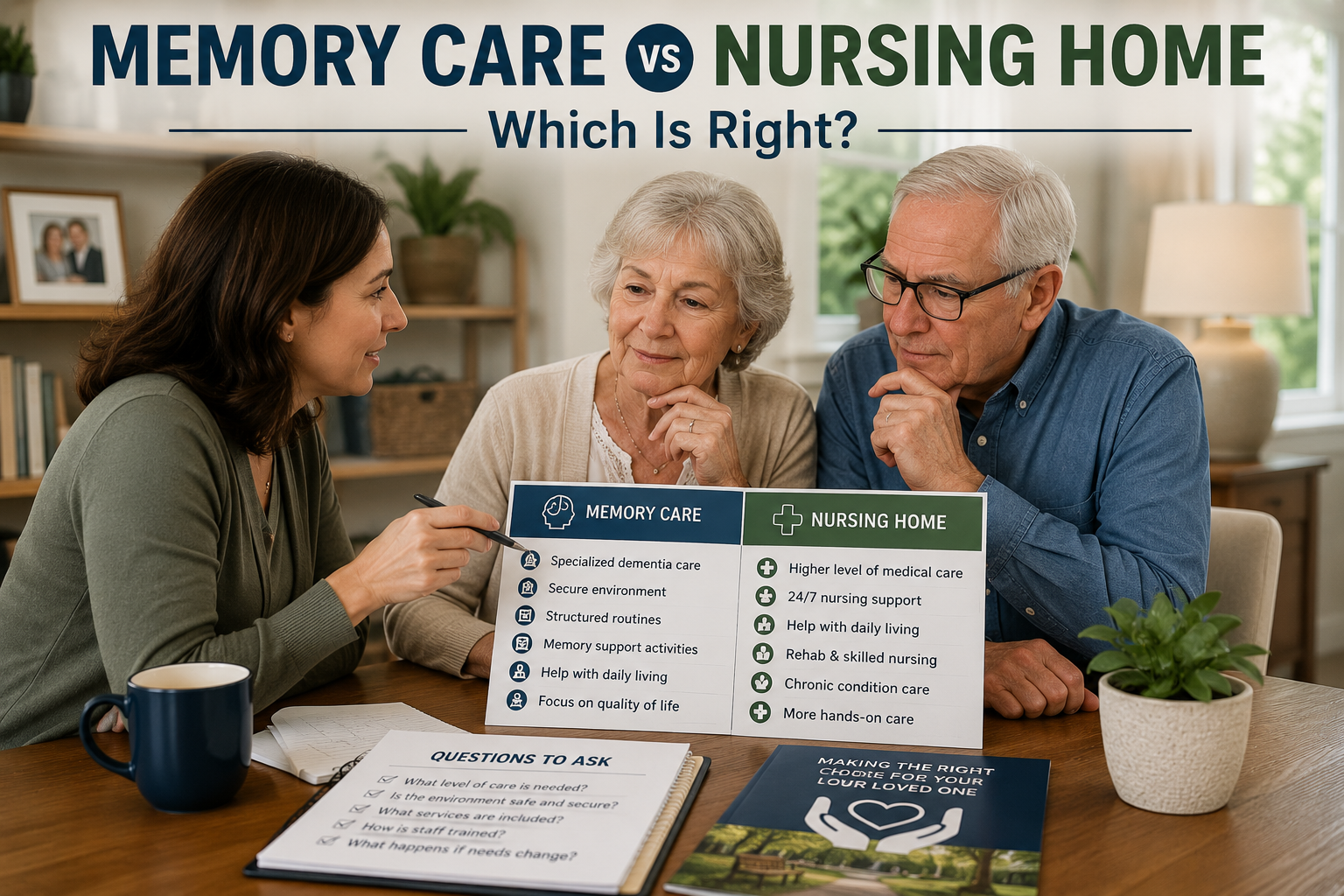
Memory care is usually designed for people living with Alzheimer’s disease, dementia, or other memory-related conditions. A nursing home usually provides a higher level of medical care, daily support, and skilled nursing for people with more complex health or physical needs.
The right choice depends on the person’s memory, safety, mobility, medical needs, behavior, supervision needs, and whether they need daily nursing support.
What Is Memory Care?
Memory care is a type of senior care designed for people with memory loss, Alzheimer’s disease, dementia, or related cognitive conditions.
Memory care may be offered in a separate memory care community, a secured unit within assisted living, or a memory care area connected to a larger senior living community.
Memory care often focuses on:
- Safety
- Supervision
- Structured routines
- Dementia-trained staff
- Help with daily activities
- Medication reminders or management
- Activities designed for cognitive support
- Secure layouts to reduce wandering risk
- Family communication
- A calmer daily environment
Memory care can be a good fit when a person has memory loss but does not necessarily need full-time skilled nursing care.
What Is a Nursing Home?
A nursing home provides a higher level of care than most assisted living or memory care settings.
Nursing homes may serve people who need:
- 24-hour care support
- Skilled nursing
- Help with bathing, dressing, eating, and toileting
- Medication management
- Mobility support
- Wound care
- Chronic condition support
- Rehab after a hospital stay
- Long-term residential care
- More hands-on daily assistance
Some nursing homes also care for residents with dementia. However, not every nursing home has a dedicated memory care program or specialized dementia unit.
This is why families should ask whether the facility provides general nursing home care, dedicated memory care, dementia care, skilled nursing, rehab, or a combination of services.
Main Difference Between Memory Care and Nursing Home Care
The main difference is the primary reason for care.
Memory care is usually focused on dementia, safety, supervision, structure, and cognitive support.
Nursing home care is usually focused on higher medical needs, skilled nursing, physical care, and long-term daily support.
A person with dementia may need memory care, nursing home care, or both depending on their condition.
Memory Care May Be a Better Fit When:
- The person has Alzheimer’s disease or dementia
- They wander or are at risk of getting lost
- They need a secure environment
- They need reminders and structure
- They need help with daily activities
- They are physically stable enough for a lower medical setting
- They do not need frequent skilled nursing care
- They benefit from dementia-focused activities
- They need staff familiar with memory loss behaviors
Memory care can help when the biggest concerns are confusion, wandering, safety, routine, and supervision.
A Nursing Home May Be a Better Fit When:
- The person needs regular nursing care
- They have complex medical needs
- They need help with most daily activities
- They have serious mobility problems
- They need help transferring from bed to chair
- They need wound care or skilled medical support
- They are recovering after a hospital stay
- They have dementia plus major physical or medical needs
- Assisted living or memory care can no longer meet their needs
A nursing home may be more appropriate when memory loss is not the only issue and the person also needs significant hands-on care.
Can a Nursing Home Provide Memory Care?
Some nursing homes provide care for residents with dementia. Some also have dedicated dementia care or memory care units.
However, families should not assume every nursing home is equally prepared for memory care needs.
Ask the facility:
- Do you have a dedicated memory care unit?
- Is the memory care area secured?
- Are staff trained in dementia care?
- How do you handle wandering?
- How do you handle agitation or confusion?
- What activities are available for residents with dementia?
- How do you communicate with families?
- What happens if the resident’s care needs increase?
- Can the facility manage both dementia and medical needs?
These questions help families understand whether the facility is truly prepared for the person’s condition.
Safety Considerations
Safety is one of the biggest reasons families compare memory care and nursing home care.
A person with memory loss may forget to take medication, leave the stove on, wander outside, fall, become confused at night, or have trouble recognizing unsafe situations.
Memory care may help with safety through:
- Secure doors
- Staff supervision
- Structured schedules
- Familiar routines
- Dementia-focused activities
- Safer building layouts
- Wandering prevention
- Family updates
A nursing home may help with safety through:
- Higher levels of physical care
- Nursing oversight
- Fall prevention
- Medication management
- Medical monitoring
- Mobility assistance
- Help with eating, bathing, and toileting
The right safety environment depends on whether the main risk is memory-related behavior, medical complexity, physical care needs, or a combination.
Cost and Payment Differences
Memory care and nursing home care can both be expensive. Costs vary by location, facility, room type, level of care, and services included.
Memory care is often private pay, although some state programs or long-term care insurance policies may help depending on the situation.
Nursing home care may be private pay, Medicaid, long-term care insurance, veterans benefits, or short-term Medicare-covered skilled nursing care if specific requirements are met.
Medicare generally does not pay for long-term custodial nursing home care by itself. Medicare may cover certain short-term skilled nursing facility care when specific rules are met, but that is different from long-term residential care.
Families should ask each facility:
- What is the monthly cost?
- What is included?
- What costs extra?
- Does the facility accept Medicaid?
- Can a resident transition to Medicaid later?
- Is long-term care insurance accepted?
- Are memory care services billed separately?
- What happens if the resident needs more care?
Always ask for a written cost breakdown before choosing.
Questions to Ask Before Choosing
Before choosing memory care or a nursing home, ask:
- What diagnosis or condition is driving the care need?
- Does the person need skilled nursing?
- Does the person wander?
- Does the person need a secure environment?
- Does the person need help with most daily activities?
- Is the person medically stable?
- Are there behavior concerns?
- Does the person need rehab?
- What level of supervision is needed?
- What happens if the person’s condition worsens?
- Is the facility licensed for the care needed?
- What is included in the monthly cost?
- What costs extra?
These questions help families avoid choosing a setting that cannot meet the person’s needs long term.
How to Decide
Memory care may be right when the main need is dementia support, safety, structure, supervision, and daily assistance.
A nursing home may be right when the person needs significant medical care, skilled nursing, mobility help, or hands-on support with most daily activities.
Some people with dementia eventually need nursing home care if their medical or physical needs become too high for memory care.
The best choice is the one that can safely meet the person’s current needs and has a clear plan if those needs increase.
Next Step
Nursing Home Placement helps families compare memory care, nursing homes, assisted living communities, rehab, retirement communities, and skilled nursing options by location and care type.
Start by browsing senior care communities near you, or use our Get Help Finding Care form if you need help narrowing down the right option for your family.