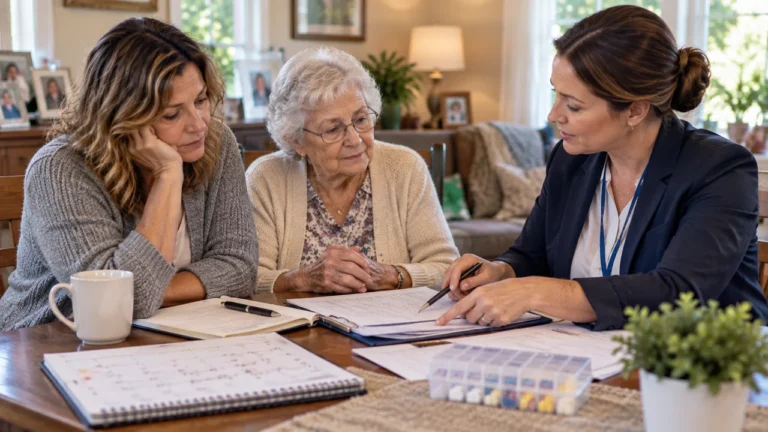
Coordinating Care for Two Aging Parents With Different Needs
When both parents need help, families often make one large “Mom and Dad” plan.
That can hide important differences.
One parent may need help with medications and meals. The other may still drive but need mobility support. One may want assisted living. The other may strongly prefer home.
The most effective approach is to create two individual care summaries plus one shared logistics plan.
Give each parent a separate one-page care summary
For each parent, list:
- current clinicians;
- major diagnoses relevant to daily care;
- medication-management needs;
- mobility and transfer needs;
- bathing/dressing/toileting support;
- hearing/vision/communication needs;
- cognitive or behavioral support;
- nutrition/swallowing concerns;
- outside appointments;
- emergency contacts;
- legal representative, if any; and
- personal preferences.
Do not assume that because they are married, one spouse can automatically consent to or manage everything for the other.
Use one shared calendar for household logistics
The care plans are separate, but the family’s time is shared.
Put both parents’ appointments and services on one calendar:
- medical visits;
- therapy;
- transportation;
- home-care shifts;
- adult day program;
- respite;
- pharmacy delivery;
- family visits; and
- bill/benefit deadlines.
Color-coding can help, but keep the system simple enough that everyone actually uses it.
Compare needs by time of day
Two moderate care needs can become one impossible schedule when they overlap.
Example:
- Dad needs transfer help at 7 a.m.
- Mom has a dialysis pickup at 7:15 a.m.
- both need breakfast support;
- the family caregiver starts work at 8 a.m.
The issue is not whether each task can be done separately. It is whether the household can cover them at the same time.
Map morning, afternoon, evening, and nighttime needs.
Keep budgets separate before combining them
Create a basic financial picture for each parent:
- income;
- insurance;
- Medicare/Medicaid status;
- long-term-care insurance;
- personal savings/resources;
- recurring care costs; and
- out-of-pocket medical expenses.
Then add shared household costs.
Do not assume one spouse’s benefit, Medicaid eligibility, or long-term-care insurance works identically for the other.
For Medicaid long-term care, spouse rules are highly specific and should be reviewed separately with the state program or qualified adviser.
Ask whether one parent’s care is masking the other’s decline
Sometimes the more visibly ill parent receives all attention.
The “healthier” spouse may quietly be:
- losing weight;
- missing appointments;
- skipping their own medications;
- becoming isolated;
- sleeping poorly;
- developing mobility problems; or
- becoming exhausted from caregiving.
NIA emphasizes caregiver self-care and notes that primary caregivers may need support and respite.
Treat the healthier spouse as a person with their own health needs, not merely as free labor.
Decide which tasks can be shared
Some services may efficiently support both parents:
- grocery delivery;
- housekeeping;
- meal delivery;
- transportation coordination;
- one family calendar;
- one home-safety review; or
- some social activities.
Other care should remain individualized:
- medication management;
- therapy goals;
- personal care;
- clinical equipment;
- diet orders;
- cognitive support; and
- medical decisions.
Do not combine individual clinical plans for convenience.
Plan for “split placement” before it becomes a crisis
Couples often want to stay together, but their needs may eventually require different settings.
Ask early:
- Could one spouse remain home while the other enters residential care?
- Are there communities offering multiple levels of care on one campus?
- Could they live in nearby settings?
- How would transportation for visits work?
- What would the at-home spouse need after the move?
- How would household finances change?
Planning does not mean the move is imminent. It prevents the family from learning every option during a hospitalization.
Use care meetings for both parents separately when needed
If one parent is in a nursing home and the other lives at home, the nursing-home care plan should still focus on the resident.
The spouse at home may need their own clinician, caregiver supports, or community services.
Do not expect the nursing home’s care-plan meeting to solve the at-home spouse’s unrelated health needs.
Create a backup plan for the primary helper
If one parent cares for the other, ask:
“What happens if the caregiving spouse becomes sick tomorrow?”
Identify:
- backup family contact;
- respite option;
- home-care agency;
- emergency medication information;
- transportation backup; and
- where essential documents are stored.
This is particularly important when one parent’s independence depends entirely on the other parent’s daily help.
Frequently asked questions
Should we try to keep both parents in the same setting?
Only if that setting can meet both people’s actual needs and preferences. Proximity matters, but care fit still needs to be individualized.
Can one spouse be the other’s caregiver indefinitely?
Sometimes, but caregiver capacity can change. Monitor the caregiving spouse’s own health, sleep, mobility, and stress, and bring meaningful changes to appropriate clinicians.
Should we combine all finances into one care budget?
You can create a household budget, but preserve the separate benefits, insurance, resources, and legal ownership relevant to each parent. Medicaid and estate rules may require qualified guidance.
The practical goal
Think two people, two care plans, one coordination system.
Keep individual needs visible while using shared calendars, transportation, household services, and backup planning to reduce duplication.
Primary/authoritative sources checked
- National Institute on Aging — Sharing Caregiving Responsibilities
- National Institute on Aging — Taking Care of Yourself: Tips for Caregivers
- National Institute on Aging — Does an Older Adult in Your Life Need Help?
- Administration for Community Living — National Family Caregiver Support Program
- ACL Eldercare Locator
Editorial/source review: October 16, 2026. General U.S. education only. Medicaid spouse rules, insurance coverage, property ownership, and legal authority are state- and case-specific.
Next step for families: Browse senior-care communities to compare local options, or use the Care Finder to organize the care needs and your next questions. Always verify current services, staffing, clinical capability, costs, and availability directly with the provider.