Choosing a Memory-Care Program That Can Adapt as Communication Changes
Memory-care communication needs can change substantially over time.
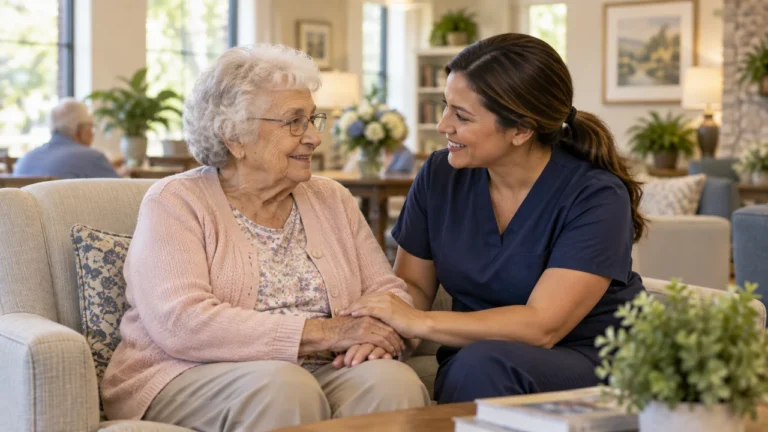
A resident may move from detailed conversation to shorter phrases, yes/no responses, gestures, facial expression, or other nonverbal communication.
Ask how the program adapts as the resident changes.
Early changes
Ask whether staff can support:
- word-finding difficulty;
- losing the thread of conversation;
- background-noise sensitivity;
- slower response time;
- difficulty with multi-step instructions.
NIA recommends simple language, patience, eye contact, and extra response time.
Later changes
Ask how staff recognize:
- pain;
- hunger;
- toileting;
- fear;
- fatigue;
- consent/refusal;
- comfort.
Nonverbal signals become increasingly important.
Hearing and vision
Communication can worsen when hearing aids are missing or vision is poor.
Ask whether staff check sensory supports before assuming cognitive decline.
Swallowing and speech-language support
Some residents develop swallowing or communication problems that warrant clinical assessment.
Ask how the program obtains speech-language pathology or medical evaluation when needed.
Communication-adaptation worksheet
Current communication strengths: ____________________
Words/phrases that work: ____________________
Yes/no reliable?: ____________________
Visual cues: ____________________
Nonverbal signals: ____________________
Hearing/vision support: ____________________
SLP/clinical referral process: ____________________
Frequently asked questions
Does less speech mean the resident understands nothing?
No.
Should staff speak louder?
Only if hearing needs it; loudness does not fix language processing.
Can family help?
Yes, by sharing familiar phrases, signals, and communication history.
The practical goal
Choose a program that can move with the resident from words to cues to nonverbal communication without withdrawing respect or choice.
Related NHP guides
Primary sources checked
- NIA — Communicating With Someone Who Has Alzheimer’s Disease
- NIA — What Are the Signs of Alzheimer’s Disease?
*Editorial/source review: October 15, 2026. General education only. Trauma-sensitive care, behavior logs, communication changes, and one-to-one supervision require resident-specific assessment, appropriate clinical review, and current facility capability verification.*