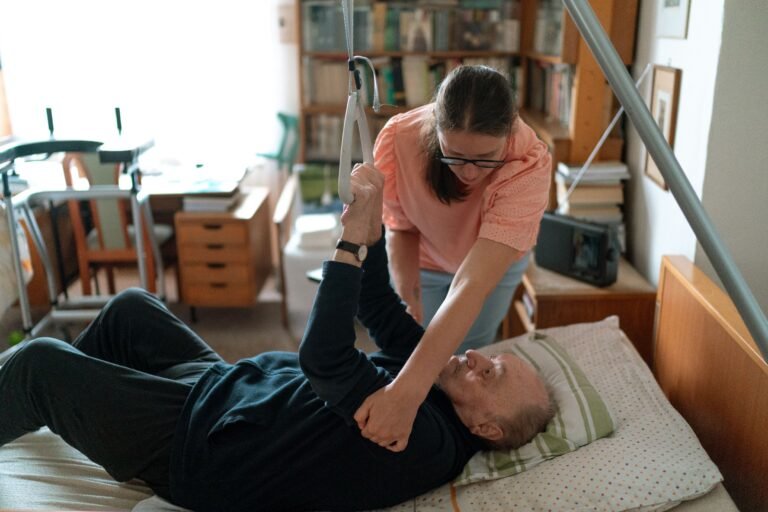
Two-Person Transfers in Assisted Living: Staffing, Lifts and License Questions
Some assisted-living communities can support a resident who needs two staff members for a transfer.
Others cannot.
There is no single national assisted-living rule that makes two-person transfers universally allowed or prohibited. State regulations, facility licensing, staffing, equipment, and the resident’s specific transfer method all matter.
This guide assumes assisted living is already being considered and focuses on whether a particular community can safely provide the exact two-person transfer assistance the resident requires. For the broader question of which care setting fits after transfer ability declines, see which care settings can help with two-person transfers.
Define the transfer first
Ask the therapy or clinical team to describe the current method.
Is it:
- two-person stand-pivot;
- sit-to-stand lift;
- full mechanical lift;
- two-person bed mobility; or
- another method?
“Needs two people” is not specific enough.
Ask whether the community’s license allows it
Assisted-living scope varies by state.
Ask:
- Can you admit someone needing this transfer?
- Can you retain them if the need develops later?
- Does a mechanical lift change the answer?
- Are there evacuation limitations?
- Does the state license impose mobility restrictions?
Get the response in writing.
Ask whether two staff are actually available
A policy allowing two-person transfers means little if only one staff member is available on the unit.
Ask about:
- mornings;
- evenings;
- overnight;
- weekends;
- call-outs; and
- busy toileting periods.
Ask about equipment
If a lift is needed:
- Who owns it?
- Who maintains it?
- Are slings resident-specific?
- Are staff trained?
- Is the room large enough?
- Can it be used in the bathroom?
Ask how the price changes
Two-person transfers may increase the care level.
Ask for:
- current monthly rate;
- transfer-related fee;
- future reassessment triggers; and
- what needs would require move-out.
See Assisted Living Levels of Care for pricing questions.
Put the transfer plan in writing
Ask the therapy or clinical team to describe the transfer in terms the assisted-living community can evaluate: whether the resident bears weight, how much participation is expected, whether a gait belt or mechanical lift is used, how many transfers occur in a normal day, and whether the same method is needed overnight.
Test the staffing answer by shift
A daytime tour can make two-person assistance sound simple. Ask who provides the second staff member on evenings, nights, weekends, and during call-outs. Ask what happens if one trained staff member is helping another resident when a transfer is needed.
Ask what would trigger another reassessment
Find out what happens if the resident moves from a stand-pivot transfer to a sit-to-stand or full mechanical lift, stops participating reliably, begins falling during transfers, or needs two-person help more often. The family should know the community’s next-step process before a crisis.
Ask the community to put the agreed transfer method, staffing expectations, equipment responsibilities, and any added care charge in writing before move-in.
A practical example
One community accepts a resident who can bear weight and needs two staff for a stand-pivot transfer.
Another community allows only one-person transfers.
A third can use a mechanical lift but only in certain apartments.
The diagnosis is the same. The operational capability is different.
Seven questions to ask
- What transfer method do you accept?
- Is two-person assistance allowed under your license?
- Are two trained staff available every shift?
- Can you use mechanical lifts?
- How does this affect monthly cost?
- What happens if transfer ability declines?
- What transfer need would require a move?
For the broader decision, see When a Parent Needs Two People to Stand.
Sources and review date
Sources checked October 11, 2026. Assisted-living transfer rules vary by state and facility.
- National Institute on Aging: Long-Term Care Facilities