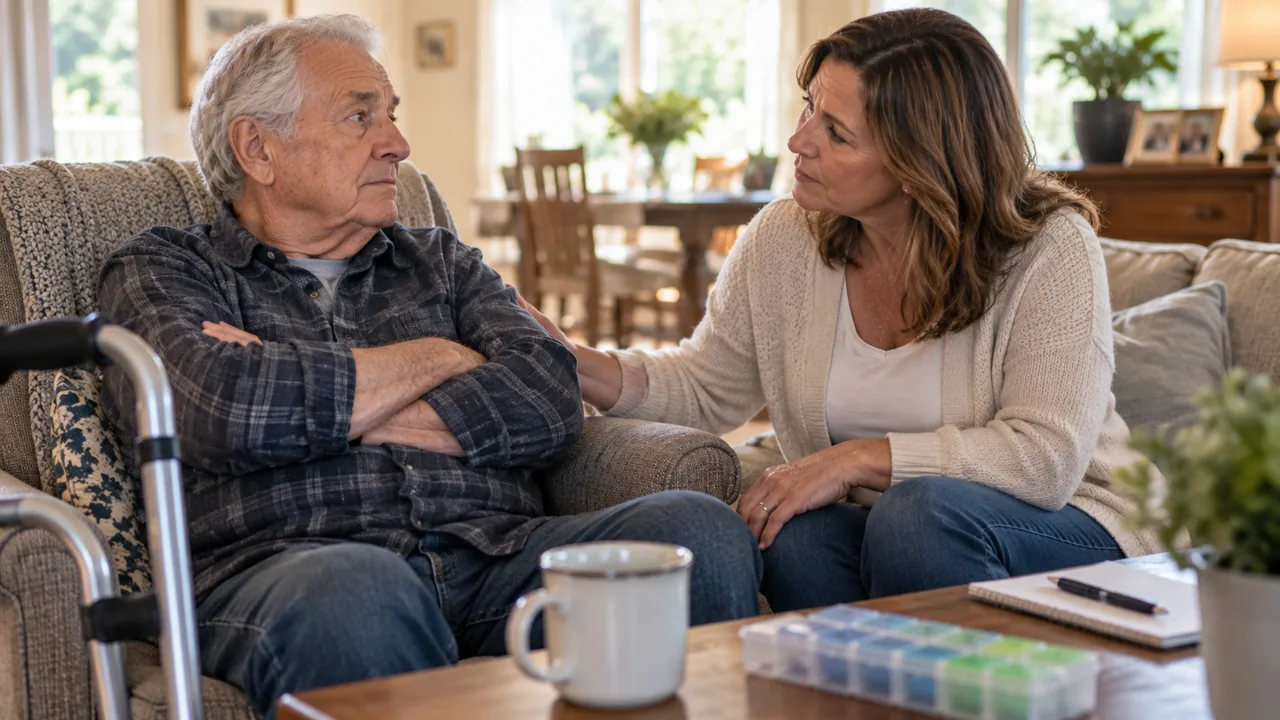
My Elderly Parent Refuses Help — What Can I Do?
You can see the problem clearly.
Your dad is missing medications. Your mom has fallen twice. The house is getting harder to manage. Driving no longer feels safe. You offer help — and the answer is still no.
That can leave families stuck between two fears: respecting a parent’s independence and waiting until something worse happens.
An older adult refusing help does not automatically mean they are incapable of making decisions. Some people understand the risks and still choose more independence than their family is comfortable with. Others may minimize problems because they are afraid of losing control, leaving home, spending money, or becoming a burden. And when dementia is involved, a person may genuinely have difficulty recognizing their own changes.
The goal is usually not to “win” an argument. It is to understand why help is being refused, what risks are actually present, what choices still exist, and when professional input is needed.
Start With the Specific Problem, Not “You Need Help”
“Mom, you need help” can sound like a judgment about competence or independence.
A more useful conversation starts with something concrete:
- “I noticed there isn’t much food in the house. Is shopping getting harder?”
- “You’ve had two falls this month. Can we talk about what would make the bathroom safer?”
- “I’m worried the evening medications are getting mixed up. What would make that easier?”
- “Driving after dark seems harder lately. What transportation would you actually be willing to use?”
The National Institute on Aging recommends raising specific concerns without sounding critical and pairing the concern with a practical offer of help.
Try to Understand What “No” Actually Means
A refusal of help may really mean:
- “I do not want strangers in my house.”
- “I am afraid you are trying to move me.”
- “I cannot afford this.”
- “I do not want to lose my car.”
- “I do not want to be a burden.”
- “I have always handled this myself.”
- “I do not think the problem is as serious as you do.”
- “I am embarrassed that I need help bathing, dressing, or using the bathroom.”
Once you know the objection, you can respond to the real concern instead of repeating the same argument.
For example, someone who refuses “home care” may accept a housekeeper, meal delivery, transportation, or a familiar relative helping with one task first. A parent who rejects “assisted living” may be more willing to tour a community simply to understand the options without agreeing to move.
Offer Choices Instead of One Big Decision
Older adults often resist when every conversation sounds like a loss of control.
When possible, break the problem into smaller choices:
- Would you rather have groceries delivered or go shopping with someone?
- Would you prefer an aide two mornings a week or help from family on specific days?
- Would you rather stop driving at night first instead of giving up driving completely?
- Would you like to tour two communities and tell us what you dislike about them before making any decision?
- Would you rather talk to your doctor first about the falls before we discuss housing?
The goal is to preserve as much control as possible while still addressing real safety needs.
Sometimes the Problem Is Fear of Losing Independence
Many older adults want to stay at home for as long as possible. The National Institute on Aging describes aging in place as a goal that can work when safety, transportation, personal care, household needs, and health support are realistically planned for.
That means the question is not simply: “Will Mom accept help?”
It is also: “What is the least intrusive support that would make the current situation safe and sustainable?”
Possible starting points may include:
- meal or grocery delivery
- transportation
- housekeeping
- medication organization or professional medication support
- home-safety changes
- an emergency alert system
- adult day services
- respite care
- in-home personal-care help
- help from family, friends, neighbors, or faith-community members
The federal Eldercare Locator can connect families with local aging services, transportation, home-care resources, caregiver support, meals, and respite programs.
What If Dementia Is Part of the Refusal?
Dementia can change these conversations.
Some people with Alzheimer’s disease or another cognitive disorder may have anosognosia, a neurologic lack of awareness of their own impairment. A person may sincerely believe they are managing medications, driving, finances, or daily activities normally even when others see serious problems.
If you suspect this may be happening:
- avoid turning every conversation into a confrontation about what your parent “cannot” do
- focus on safety and routines rather than proving them wrong
- involve a health care professional experienced with cognitive changes
- introduce support gradually when possible
- use familiar people and predictable routines
- document specific incidents so clinicians have concrete information
Do not diagnose anosognosia or dementia yourself. New or worsening confusion, memory problems, personality changes, or poor judgment should be discussed with an appropriate health care professional.
What If My Parent Understands the Risk and Still Says No?
This is one of the hardest situations for adult children.
Adults who can understand their situation and make informed decisions generally retain significant control over their own choices, even when family members strongly disagree. Whether someone has the ability to make a particular decision can become complicated when cognition, mental status, or serious illness is involved.
If you are unsure whether your parent can understand the risks and consequences of the decision, ask the appropriate clinician and, when legal decision-making authority is at issue, seek qualified legal guidance in your state.
If Your Parent Keeps Falling and Still Refuses Help
Repeated falls deserve more than another family argument. They are a concrete reason to ask for a fall-risk evaluation and to reduce hazards while the larger care discussion continues.
The CDC recommends talking with a health care provider about fall risk, reviewing medicines that may cause dizziness or sleepiness, checking vision, strengthening balance when appropriate, and reducing home hazards such as poor lighting, throw rugs, missing handrails and the lack of bathroom grab bars.
If your parent refuses to discuss assisted living, you can still ask for one smaller next step:
- a medical visit focused specifically on the falls
- a medication review with the doctor or pharmacist
- a vision check
- grab bars, brighter lighting and stair railings
- a physical or occupational therapy assessment when appropriate
- an emergency alert system
- temporary in-home help during the times falls are most likely
A serious fall, head injury, sudden confusion, inability to get up, severe pain or another urgent medical problem should be evaluated promptly. Do not wait for agreement about long-term housing before addressing an immediate injury or safety concern.
Watch for the Difference Between “I Don’t Like This” and Immediate Danger
Not every refusal is an emergency.
But some situations require faster action. Examples include:
- a serious fall or injury
- acute confusion or a sudden change in mental status
- inability to obtain food, medications, or essential medical care
- unsafe wandering
- fire or cooking hazards
- driving that poses an immediate danger
- threats of self-harm or harm to others
- suspected abuse, neglect, exploitation, or abandonment
If there is an immediate medical or safety emergency, contact the appropriate emergency service rather than trying to solve the entire long-term-care question first.
Get the Doctor Involved Without Making the Doctor the “Bad Guy”
A clinician can sometimes help families move from a vague argument to a specific care plan.
Before the appointment, write down examples such as falls, medication mistakes, unsafe driving incidents, weight loss or missed meals, difficulty bathing or dressing, confusion about bills or appointments, nighttime wandering, and hospital or emergency-room visits.
Ask what level of assistance is needed now and whether any medical, medication, vision, mobility, hearing, or cognitive issue could be contributing.
The goal is not to ask a doctor to order your parent to move. It is to understand the needs and risks more accurately.
If Your Parent Refuses Assisted Living or a Nursing Home
Do not begin with the building. Begin with the care problem.
- What tasks can no longer be managed safely at home?
- How many hours of help are actually needed?
- Is overnight supervision needed?
- Are memory or wandering concerns present?
- Is skilled nursing or rehabilitation needed?
- What home-care options have realistically been tried?
- What is the backup plan if the current arrangement fails suddenly?
Then compare settings against those needs.
If your parent needs regular help with daily activities but not continuous nursing care, assisted living may be worth comparing. If dementia-related supervision is the main concern, memory care may fit better. If substantial hands-on assistance or ongoing nursing oversight is needed, a nursing home or skilled setting may be more appropriate.
Our nursing home vs. assisted living guide explains some of those differences.
If you know something needs to change but are not sure what level of care to compare, use the Care Finder to organize the situation.
What If We Keep Having the Same Argument?
Repeated pressure can make both sides more defensive.
Try changing the goal of the conversation from “convince Mom to move” to “agree on one next step.”
That next step might be:
- a doctor’s appointment
- a home-safety assessment
- trying meal delivery
- hiring help for one task
- stopping night driving
- touring one community with no commitment
- having a trusted friend, sibling, clergy member, social worker, or care manager join the conversation
- creating an emergency backup plan
One small agreement can be more useful than another two-hour argument about the entire future.
Create a Backup Plan Before There Is a Crisis
Even if your parent refuses major changes today, your family can still prepare.
- who should be called after a fall or hospitalization
- current medications and physicians
- important insurance information
- who has legal authority, if anyone, to make decisions when your parent cannot
- which family members can respond quickly
- what home support could be arranged on short notice
- which care settings you would compare if home suddenly became unsafe
Advance planning gives families more options and allows older adults to express their preferences while they are able to do so.
A Simple Conversation to Try
You do not need a perfect script. You can start with four parts:
- Observation: “I noticed you fell twice this month.”
- Concern: “I’m worried you could get hurt when no one is here.”
- Respect: “I know staying independent is important to you.”
- Choice: “Would you rather talk with the doctor about the falls first, or try having someone help here a couple mornings a week?”
That is different from: “You can’t live alone anymore. We’ve decided you’re moving.”
Take the Next Step
If your parent is refusing help, you may not be able to solve every issue in one conversation.
Start by identifying the specific risks, the amount of help actually needed, and the smallest realistic change your parent may accept.
If you are unsure whether the situation calls for more help at home, assisted living, memory care, nursing-home care, rehabilitation, or another option, use Nursing Home Placement’s Care Finder to organize the next step.
If you already know the type of care you need, you can also browse senior care communities and compare options by location and care type.
This article provides general caregiver and care-planning information. It is not medical, legal, capacity, guardianship, abuse-investigation, or emergency advice. Laws and decision-making authority vary. If there is an immediate safety or medical emergency, contact the appropriate emergency service.