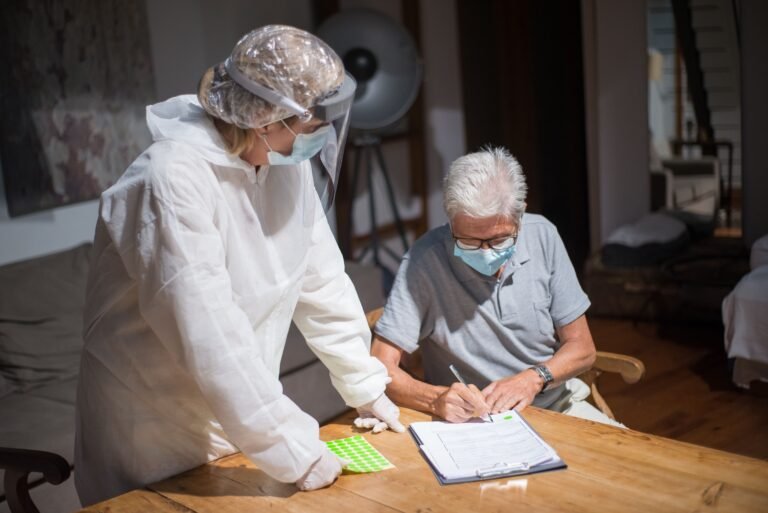
Nursing Home Admission Checklist: Documents, Assessments & Signatures
A nursing home admission usually involves three separate checks: whether the facility can meet the person’s needs, whether the required care information and screening are complete, and how the stay will be paid for. An available room or a signed application does not confirm all three.
Ask the admissions coordinator for the facility’s current requirements and a named contact for anything missing. Use this checklist to organize the process, not as a substitute for state requirements, a clinical assessment, or the facility’s admission instructions.
First, confirm what has actually been accepted
Before collecting more paperwork, ask: “Has the clinical team accepted my parent’s current needs, or are we still being evaluated?” Then confirm the proposed room, arrival date, payment arrangement and remaining conditions.
A hospital referral is not necessarily an admission approval. Neither is an insurance card. Ask which decision is pending and who makes it. If you are still selecting a facility, begin with our step-by-step nursing home search guide rather than treating paperwork as the whole search.
Medical information: ask the care teams to send it securely
At Medicare- or Medicaid-certified nursing facilities, federal rules require physician orders for immediate care at admission. The facility also conducts its own resident assessment. A family-created medication list is useful background, but it is not a replacement for valid clinical orders.
Ask which of the following are needed and who will supply them:
| Information to organize | What to confirm |
|---|---|
| Current medical history and discharge summary | The receiving team has the current version, not only an earlier referral. |
| Medication list, allergies and recent changes | The responsible clinicians reconcile discrepancies and confirm the next doses and supplying pharmacy. |
| Nursing and therapy instructions | The facility accepts the actual services needed, including any equipment or transfer assistance. |
| Eating, communication and supervision needs | Relevant clinical instructions and practical support needs are included. |
| Requested screening or test records | The facility identifies the applicable state or admission requirement and whether an existing result is acceptable. |
| Clinician and representative contacts | Staff know whom to reach about orders, consent and urgent questions. |
Do not independently stop, restart or change medicines to fit a move-in schedule. Ask the sending and receiving clinicians to resolve any gap. Use the providers’ secure records process rather than an ordinary directory inquiry form for medical documents.
Ask about preadmission screening
A Medicaid-certified nursing facility generally participates in Preadmission Screening and Resident Review, or PASRR. The federal PASRR overview describes preliminary screening for serious mental illness or intellectual disability and further evaluation when indicated.
Do not assume screening is irrelevant because someone will pay privately. Ask the hospital, facility or state screening contact what applies to this admission, who initiates it, and whether a transfer or other exception changes the process. PASRR is not the same as applying for Medicaid financial eligibility, and it is not a form the family should try to diagnose or complete without guidance.
Keep insurance and financial records separate from the care packet
Ask the billing team which cards, benefit notices, authorization details or financial records it needs. Record whether payment is approved, pending, private pay, or still unresolved.
For a proposed Medicare-covered skilled stay, ask who has checked the qualifying hospital status, skilled-care need, available benefit days and facility or plan requirements. Medicare’s skilled nursing rules distinguish these conditions from simply needing somewhere to live. The usual three-day inpatient requirement concerns that coverage pathway; it is not a universal rule that every nursing home resident must first spend three days in a hospital.
For private pay, obtain the assessed rate, extra charges, deposit terms and billing contact. Our private-pay nursing home guide explains what to verify before committing money. Do not count an unapproved insurance claim as a confirmed payment.
Understand the role of anyone signing
Ask for an unsigned admission agreement to review. Identify which lines are for the resident, an authorized representative, an emergency contact or someone accepting a payment obligation. Those roles are not interchangeable.
For federally certified nursing facilities, 42 CFR 483.15 prohibits requiring a third party’s personal payment guarantee as a condition of admission, expedited admission or continued stay. A representative with legal access to the resident’s money may agree to pay from the resident’s funds without assuming personal financial liability. Facilities also cannot require a promise not to apply for Medicare or Medicaid.
Ask an appropriate attorney about unclear language or authority to sign. Being an adult child or the main family contact does not, by itself, answer every legal-authority question. State law and the particular documents matter.
Add a short personal introduction
Alongside the formal records, offer a brief note about the person: preferred name, language, usual routine, hearing or vision supports, favorite activities, and how they communicate discomfort. Ask what information the team finds most useful.
Include your parent in this conversation as much as possible. The purpose is to help staff know a person, not to reduce them to a list of diagnoses.
Before arrival, close the loop
Use one final call to ask the receiving team to confirm these items:
- Clinical acceptance and the actual room or unit are confirmed.
- Required orders, records and screening results have arrived.
- Medication, equipment, transport and first-meal arrangements are clear.
- Charges, coverage status and signature roles are understood.
- A named staff member will receive the resident, and the family knows when to expect the first update.
Mark missing items with an owner and next step. “The hospital sent it” and “the facility received and reviewed it” are different answers.
There is no universal admission timeline. If care is urgently needed and an item remains unresolved, ask the treating team and admissions coordinator about a safe interim arrangement rather than assuming arrival can go ahead.
Frequently asked questions
Is a power of attorney always required?
Do not assume so. The resident may be able to make their own decisions and sign their own documents. When someone else is acting, ask what authority is needed for that specific task and obtain legal guidance about disputed or unclear authority.
Do all nursing homes require the same medical tests?
No single national checklist answers every admission. Ask the facility to identify the current requirements for its state and the person’s situation, including what records can be supplied instead of repeated testing.
Does completing the packet guarantee admission?
No. The facility must still confirm care capability, the accommodation and the applicable payment arrangement. Ask what remains conditional before arranging the move.
Ready to compare an appropriate facility?
An organized admission packet helps once you have a suitable option. It cannot make an unsuitable facility meet your parent’s needs.
If the right care setting is still unclear, use the Care Finder to organize your needs. Directory inclusion does not verify current openings, clinical acceptance, certification, prices or insurance participation.
Editorial review: October 8, 2026. This article provides general information, not a personal medical, legal, financial, insurance or eligibility determination. Confirm current requirements and the actual care arrangement with the appropriate professionals, agencies, payer and provider.