My Parent Cannot Climb the Stairs Anymore: Housing and Care Options
When stairs become the obstacle that divides an older adult from the bedroom, bathroom, laundry, front door, or kitchen, families often assume a move is inevitable.
Sometimes it is.
But losing the ability to climb stairs does not automatically mean a parent needs assisted living or a nursing home. The right decision depends on why stair climbing became difficult, whether the home can be made usable without stairs, and what other daily-care needs are changing at the same time.
The first question is not “Where should Mom move?” It is:
What changed, and can the home be reorganized safely around that change?
A new inability to climb stairs deserves evaluation
If your parent previously handled stairs and suddenly cannot, tell a healthcare professional.
Possible contributors can include:
- pain;
- arthritis flare;
- weakness after illness or hospitalization;
- shortness of breath;
- heart or lung problems;
- dizziness;
- medication effects;
- balance problems;
- vision changes;
- foot problems;
- neurologic problems; or
- a recent fall or injury.
Seek urgent care for sudden weakness, chest pain, severe shortness of breath, stroke symptoms, a serious injury, or another medical emergency.
Do not treat a sudden mobility decline as ordinary aging until the cause has been considered.
Ask whether the problem is strength, balance, pain, endurance, or fear
“Cannot do the stairs” can mean very different things.
Your parent may:
- lack the leg strength to rise step by step;
- become short of breath halfway up;
- have knee or hip pain;
- feel dizzy;
- struggle to see the stair edges;
- freeze or lose balance when turning;
- be afraid after a previous fall; or
- manage the stairs going up but not down.
The solution depends on the limiting factor.
A physical therapist or other qualified clinician may be able to assess gait, strength, balance, endurance, and assistive-device needs. An occupational therapist may help evaluate how the home layout affects everyday activities.
Medicare covers physical and occupational therapy in the home for people who meet its home-health eligibility requirements, but eligibility is based on specific skilled-service and homebound criteria.
Do not “practice through” an unsafe staircase
Families sometimes respond to decline by telling the parent to use the stairs more often so they do not “lose the ability.”
Exercise can be valuable, but a hazardous staircase is not a substitute for a safe rehabilitation plan.
If your parent is unsteady, has fallen, becomes breathless, or cannot manage the stairs without hands-on assistance, stop treating the stairs as an informal workout and ask for professional guidance.
Check the staircase itself
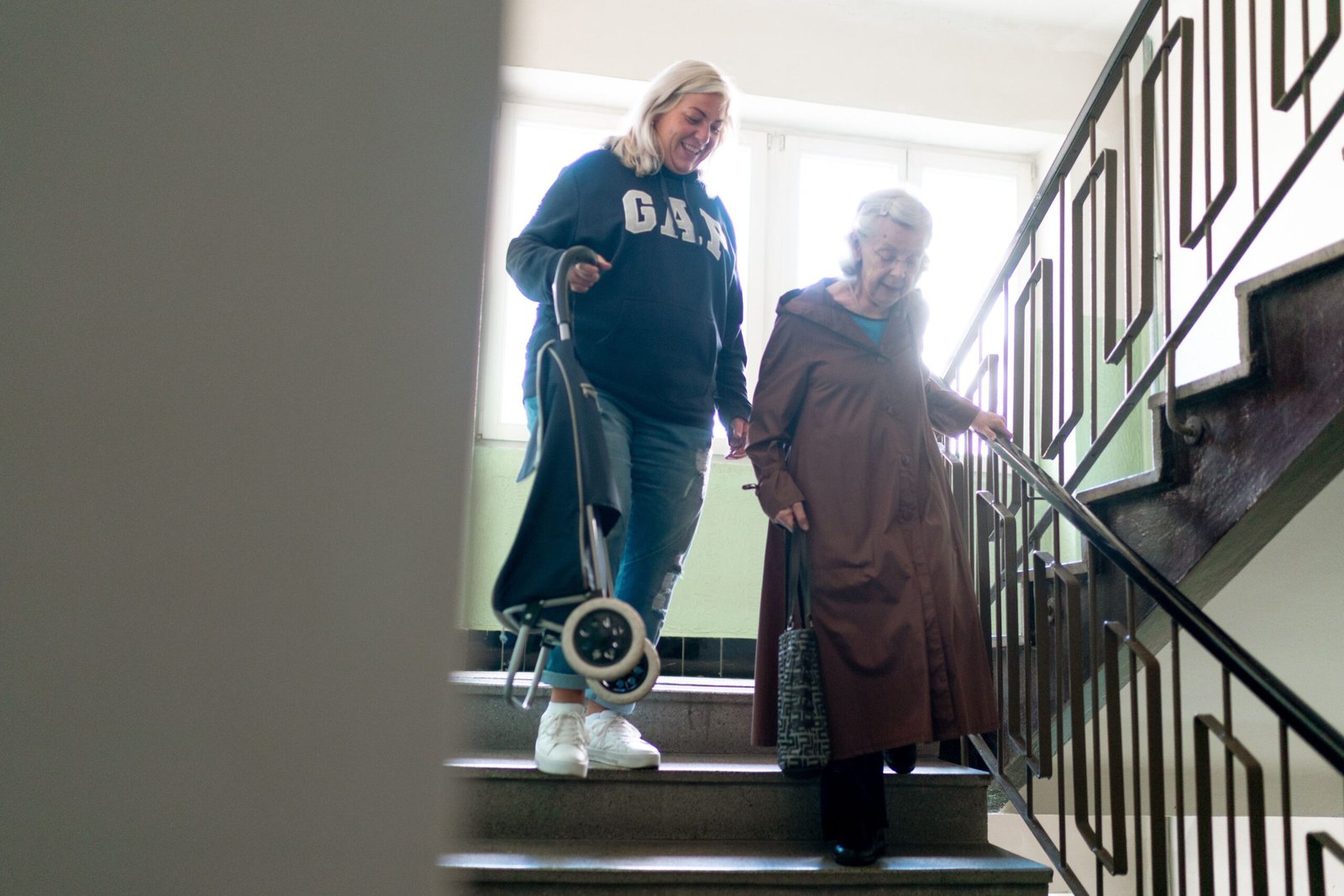
The National Institute on Aging recommends making stairs and hallways safer with measures such as secure handrails on both sides and good lighting, including switches at the top and bottom.
Walk the stairs carefully and check:
- Are the handrails secure?
- Are there rails on both sides?
- Can the person grip them?
- Is lighting bright and even?
- Are step edges easy to see?
- Is carpeting loose?
- Are objects stored on the stairs?
- Are there extension cords nearby?
- Does the person carry laundry or other items that block the view?
- Are pets creating a trip risk?
- Is there a landing to rest?
- Are the stairs unusually steep or narrow?
Home-safety improvements may reduce risk, but they do not make every staircase appropriate for every mobility level.
Consider whether your parent can live on one floor
Before planning a move, ask whether the home can function without routine stair use.
Could the family create:
- a first-floor bedroom;
- a first-floor bathroom;
- a temporary sleeping area;
- a laundry solution that does not require basement stairs;
- meal storage or preparation on the main level;
- a safer entrance; or
- a way to reach essential rooms without steps?
This can be surprisingly effective when the rest of the home still works well.
But be realistic.
Putting a bed in the living room is not a complete solution if the only bathroom is upstairs.
Home modifications may extend safe independence
NIA recommends correcting immediate dangers and making the home safer and easier to navigate as part of aging in place.
Depending on the home and the person’s abilities, families may explore:
- additional handrails;
- improved lighting;
- ramps at entrances;
- bathroom modifications;
- threshold changes;
- wider pathways;
- rearranged furniture;
- a stair lift;
- a platform lift; or
- other accessibility work.
A stair lift or other major modification should be evaluated for the specific person and home. The user still has to transfer on and off safely, understand how to operate the equipment, and reach essential rooms at both ends.
Use qualified installers and follow local building and safety requirements.
Do not assume a stair lift solves every care problem
A lift may solve vertical access while leaving other problems untouched.
Ask whether your parent can:
- get out of bed;
- transfer to the stair-lift seat;
- manage the seat belt or controls;
- get off safely at the other end;
- use the bathroom;
- bathe;
- dress;
- prepare food;
- take medications;
- respond to emergencies; and
- leave the house if there is a fire or power outage.
If those tasks are also becoming difficult, the stairs may simply be the most visible part of a broader decline.
Option 1: remain at home with a one-floor plan
This can work when the person is otherwise relatively independent and the home’s essential spaces can be made accessible.
A one-floor plan may be especially reasonable when:
- mobility is expected to improve;
- the home can be modified;
- help is available for tasks such as laundry;
- the parent strongly prefers to stay;
- transportation is manageable; and
- the caregiver burden remains realistic.
NIA describes aging in place as staying in one’s home while adding health, personal, and other support services as needed.
Option 2: remain at home with personal-care help
If stairs are only one part of the problem, an aide may help with:
- bathing;
- dressing;
- meals;
- toileting;
- transfers;
- light housekeeping; and
- moving safely through the home.
NIA notes that personal care includes activities of daily living such as bathing, dressing, grooming, toileting, eating, and moving around.
Our home care vs assisted living guide can help compare paid help at home with residential care.
Option 3: move to a more accessible home
The right answer may be a move without a change in “care level.”
Examples include:
- a one-story house;
- an apartment with elevator access;
- a senior apartment;
- an accessible condominium;
- an accessory dwelling unit near family; or
- living with relatives in a home that is easier to navigate.
This can be a good fit when the parent primarily needs a more accessible environment rather than daily personal-care staff.
Before choosing a new home, test:
- entrance access;
- elevator reliability;
- distance from parking;
- bathroom layout;
- door widths;
- flooring;
- emergency exits;
- laundry access; and
- how the person would function if mobility declines further.
Option 4: independent senior living
Independent senior communities may reduce home-maintenance burdens and offer features such as elevators, accessible layouts, meals, transportation, social activities, or emergency-call systems.
But independent living is not the same as assisted living.
Ask what personal care is not included.
A parent who cannot climb stairs but otherwise lives independently may do very well in an accessible independent-living setting.
A parent who also needs help bathing, transferring, managing medications, or toileting may need more support.
Option 5: assisted living when mobility decline comes with daily-care needs
Assisted living may fit when stair difficulty is part of a larger need for regular personal care.
Examples include needing help with:
- bathing;
- dressing;
- medication;
- meals;
- toileting;
- transfers;
- walking longer distances; or
- nighttime safety.
Ask how the community evaluates mobility before move-in.
Our article on assisted-living assessments explains how transfers, wheelchair use, walking distance, and other care needs can affect admission and pricing.
Test the actual distances inside assisted living
Eliminating stairs does not automatically eliminate mobility demands.
An assisted-living apartment may still be:
- a long walk from the dining room;
- far from the elevator;
- separated from activities by long corridors;
- difficult to navigate with a walker; or
- dependent on the resident being able to transfer independently.
Ask to walk the route your parent would use.
If your parent needs a wheelchair for distance, ask who pushes it and whether that assistance is included.
Nursing-home care may be appropriate when mobility needs are intensive
A nursing home may be a better fit when stair difficulty reflects broader physical or medical needs such as:
- inability to bear weight;
- two-person transfers;
- mechanical-lift use;
- severe weakness;
- frequent nursing assessment;
- complex wounds;
- swallowing or feeding problems; or
- significant cognitive impairment plus extensive hands-on care.
The inability to climb stairs is not the reason for nursing-home care. The broader care requirements are.
Plan for emergencies, not just ordinary days
A home modification is only successful if your parent can function during emergencies too.
Ask:
- How would they exit during a fire?
- What if the elevator is unavailable?
- What if a stair lift loses power?
- Can emergency responders reach the bedroom?
- Is there a second safe exit?
- Can the person reach a phone or alert device?
- Who checks on them during a power outage?
Accessibility is part of emergency planning.
A practical example
Suppose Carlos’s mother stops using the second floor after a knee problem and two near-falls.
The family initially begins touring assisted living.
Then they separate the problems.
Her bedroom and full bathroom are upstairs, but she still cooks, manages medications, drives locally, and handles finances. A clinician evaluates the knee and balance issues. The family creates a temporary first-floor sleeping space, improves lighting and rails, and brings in occupational therapy to evaluate the home.
If she recovers enough, she may remain at home.
If the stairs remain unusable, the family may decide that an accessible apartment makes more sense than assisted living because she does not yet need personal care.
That is a very different decision from “stairs equal assisted living.”
Five questions before deciding whether to move
- Why did stair climbing become difficult? New weakness, pain, dizziness, breathlessness, or balance change may need medical evaluation.
- Can essential daily life happen on one floor? Bedroom, bathroom, food, entrance, and emergency exit all matter.
- Would a home modification actually solve the problem safely? Assess transfers, cognition, equipment use, and emergency backup.
- What other daily tasks are changing? Bathing, toileting, medications, meals, and transfers may matter more than the stairs themselves.
- Does my parent need a more accessible home or more hands-on care? That distinction helps separate an accessible apartment or independent living from assisted living or nursing-home care.
If a move becomes the best option, browse senior-care communities and compare the actual walking distances, transfer assistance, accessibility, and care services rather than assuming a step-free building will meet every mobility need.
Sources and review date
Sources checked October 11, 2026. This article provides general U.S. care-planning information. New mobility loss, severe weakness, chest pain, shortness of breath, stroke symptoms, or serious injury should be medically evaluated as appropriate.
- National Institute on Aging: Preventing Falls at Home: Room by Room
- National Institute on Aging: Falls and Fractures in Older Adults: Causes and Prevention
- National Institute on Aging: Aging in Place: Growing Older at Home
- National Institute on Aging: Services for Older Adults Living at Home
- National Institute on Aging: Long-Term Care Facilities: Assisted Living, Nursing Homes, and Other Residential Care
- Medicare: Home Health Services