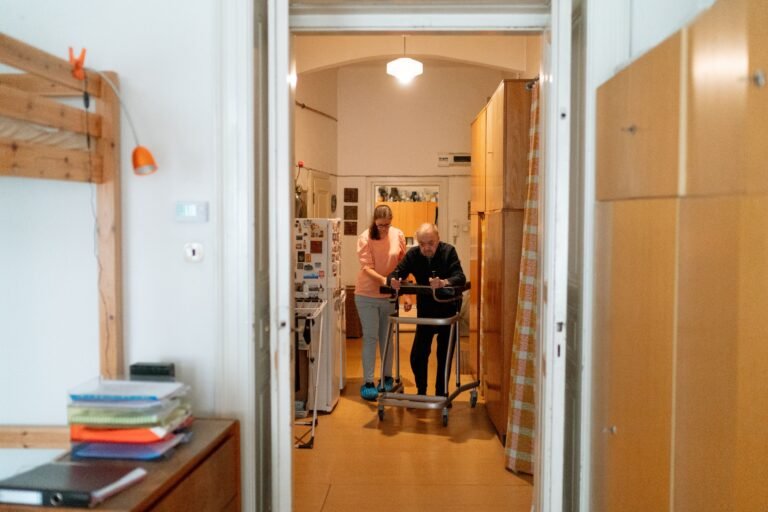
Memory Care After a Hospital Stay: Restoring Familiar Routines
A hospital stay can disrupt sleep, mobility, medication routines, eating, toileting, and orientation.
For a person with dementia, returning to memory care may be reassuring because the environment is familiar—but the resident may not immediately return to their prior baseline.
Treat the return as a fresh transition.
Reconcile the hospital handoff
Confirm:
- medication list;
- discontinued medicines;
- new medicines;
- diet;
- swallowing plan;
- mobility restrictions;
- wounds;
- oxygen/equipment;
- follow-up appointments;
- pending tests.
Compare function with pre-hospital baseline
Ask:
- Is the resident walking the same?
- Transferring the same?
- Eating the same?
- Sleeping the same?
- Communicating the same?
- More confused?
- More incontinent?
- More fearful?
Restore familiar cues
Use:
- usual room setup;
- familiar staff;
- personal history sheet;
- preferred music;
- normal meal schedule;
- usual bedtime;
- familiar clothing.
Watch for delirium or medical change
New confusion after hospitalization should not automatically be attributed to dementia.
Ask the clinical team whether delirium, infection, pain, medication effects, dehydration, or another issue needs evaluation.
Post-hospital memory-care worksheet
Hospital dates/reason: ____________________
Medication changes: ____________________
Mobility change: ____________________
Diet/swallowing: ____________________
Equipment: ____________________
Current cognition vs baseline: ____________________
Familiar routines restored: ____________________
Follow-up appointments: ____________________
Frequently asked questions
Should family expect several “off” days?
Recovery varies. Track the trend and report concerning changes.
Should the room be rearranged for new equipment?
Only as needed while preserving recognizable landmarks when possible.
What if behavior is much worse?
Ask for clinical reassessment.
The practical goal
Rebuild the resident’s familiar world while treating new medical and functional changes as real transition issues.
Related NHP guides
- A Parent Returns to the Hospital Before Settling Into the Nursing Home
- After Hospital Delirium: Is Returning Home Safe Yet?
Primary sources checked
*Editorial/source review: October 15, 2026. General education only. Trauma-sensitive care, behavior logs, communication changes, and one-to-one supervision require resident-specific assessment, appropriate clinical review, and current facility capability verification.*